
The Deep End
Eleventh Sunday after Pentecost (Proper 14), Year A

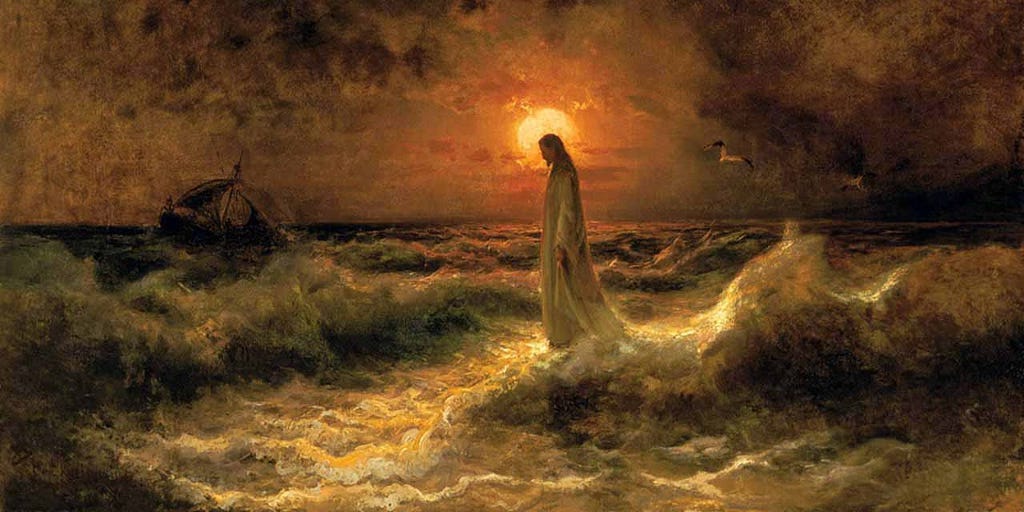
Genesis 37:1-4, 12-28 | 1 Kings 19:9-18 | Romans 10:5-15 | Matthew 14:22-33
I remember the day I thought I could walk on water. My junior cadet basketball team had just finished our season, and a few parents took our team to a timeshare for a weekend celebration. This timeshare had everything a five year old could ever want: swimming, fishing, ping pong, board games, smores, pedal boats, and basketball courts. I remember being overwhelmed by the excitement of the fun that awaited us that weekend. I was practically bouncing off the walls.
This excitement came to a head on our first visit to the indoor pool, just a couple hours after our arrival to the condo. I was feeling rather empowered to take my fun into my own hands. Once our chaperones escorted us to the pool, I found my way to the dressing room. I changed into my swimming trunks and began rehearsing in my mind the cannon ball form that would impress all my friends. I had all I needed. Without mentioning a word to anyone else, I quickly departed the locker room and made a beeline right for the pool. I picked up steam and leaped right into the eight-feet section of the pool – down in the “deep end” where the big kids swam.
All was right in the world until I realized that I didn’t know how to swim. There are few instances in life where fear is as intense as when we are thrust into, or perhaps even voluntarily submitted to, a dicey situation where we are woefully ill-equipped to manage the dangers or uncertainties that await us. I, of course, had been in water before. What I didn’t realize was that “swimming” was a much different experience when you have floaties and a life jacket as opposed to when you do not. The only thing I knew to do next was to beg for help. My arms flailed as I struggled to keep my head above water. In between gargled breaths, I cried out, “Help me! Help me!” After what felt like an eternity, my team’s assistant coach finally heard my cries from the locker room and immediately jumped in to save me.
I’m still not a very good swimmer, but after all these years, I carry the lesson of that day with me: some pools of water demand access to powers beyond ourselves if we are to tread into their depths. I imagine Peter had a similar revelation when his feet began to sink beneath the surface of the sea.
“Lord, if it is you…” feels like the language of testing and validation. It’s the daring language of temptation that convinces one out of a boat, as it were, where they belong. Peter doesn’t seem as interested in the identity of the “ghost” as much as he is his access to a reality-altering power. In this sense, Peter’s doubt precedes his brush up with a violent wind, and he proves himself to be one of “little faith” before he even stepped out of the boat.
Peter’s struggle with faith insufficient to walk on water does not seem to be about the quantity of his faith, as if our trust in God could be measured in a cup or with currency of some sort. Rather, what if Peter’s struggle is about the quality of his faith? What if his struggle began in the self-aggrandizing values he imposes on Christ in asking him to prove his identity through what Peter could do? To make it plain, Peter’s conditional statement, his “if-then” bargain with God, offers some evidence that Peter’s primary associations of Jesus are with the wrong sorts of things – supernatural power, command of the natural world, authority beyond limits. Peter, perhaps, gets caught up in his own desire for proximity to power and self-sufficiency.
Therein lies the real power of Kyrie, sōson me, “Lord, save me.” This cry for help is not only a plea for self-preservation and survival, but it is also an invitation to community and interdependence. It is the declaration that Peter stands in need of another. It is the realization that Peter, that we, cannot do this life alone. “Lord, save me” is a confession that life is gift – one that it is not ours to possess, manipulate, or dictate. Life belongs to the Giver of Life, and it is he who brings life through his death.
The other disciples in the boat respond to this stormy scene with a confession of their own, “Truly you are the Son of God” (14:33). The only other place that phrase is mentioned in Matthew is by the centurion at the foot of the cross (27:54). What the centurion witnessed, and what Peter would come to learn, is that Jesus’ divinity is most intensely and most clearly expressed on the cross. It is his submission to a crucifix, not his dominion over the sea, that truly reveals himself as the Son of God. However, the stormy sea and the cross find their connection in the purpose of Jesus’ life and ministry: to save those who are in need of saving. As Paul writes in Romans 10:12-13, “For there is no distinction between Jew and Greek; the same Lord is Lord of all and is generous to all who call on him. For ‘everyone who calls on the name of the Lord shall be saved.’”
Jesus, in freely giving his body and blood for the world, has invited us to drop our notions that salvation belongs to those who deserve their saving or who can afford their saving. Lest we forget the hubris of needing to meet Jesus on the water, may we remember that salvation is not about exercising dominion over our circumstances or even remaining unscathed by them. Salvation belongs to those who call on the name of the Lord and recognize him as the crucified God who accompanies us into the stormy waters of fear and suffering. Our recognition of who we are and our confession of who he is gifts us the faith to see even arm-flailing desperation and sinking efforts as sacraments – as sites where God touches our pain and doubt with nail-pierced hands.
“Take heart, it is I; do not be afraid”
If this post encouraged you, challenged you, or helped you feel less alone as you seek to faithfully navigate the present moment, drop a drachma on the collection plate.